
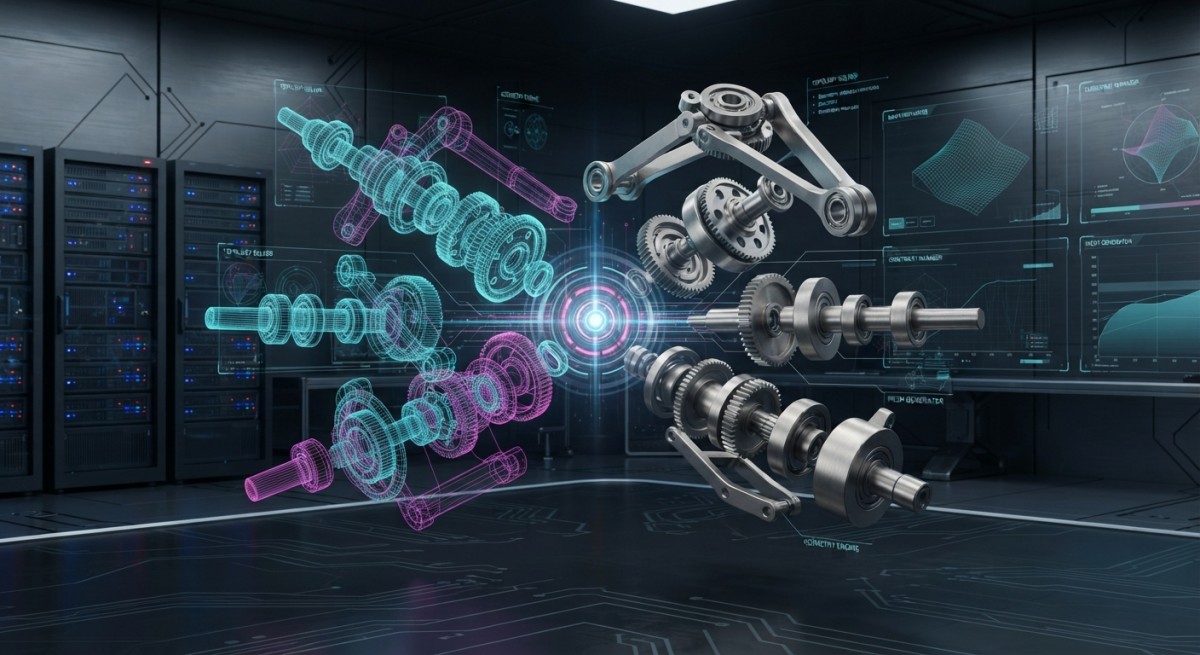
Modern 3D engineering applications depend on reliable mathematical foundations for representing and manipulating digital models. A geometric kernel provides many of the underlying capabilities required to create precise solids, surfaces, curves, and other geometric entities. For developers building CAD, CAM, CAE, visualization, or specialized engineering applications, the architecture of this foundation can influence accuracy, performance, and the flexibility of the final product.
A well-designed kernel does more than store shapes. It provides operations for creating, modifying, analyzing, and combining geometric objects while maintaining relationships between different elements. This makes it an important part of software that needs to work with detailed engineering models and demanding 3D workflows.
Understanding Kernel Architecture
A geometric kernel typically consists of multiple interconnected capabilities that work together to represent three-dimensional geometry. These can include mathematical descriptions of curves and surfaces, topological structures, modeling operations, and methods for maintaining relationships between geometric entities.
The separation between geometry and topology is particularly important. Geometry describes the mathematical shape of an entity, while topology describes how entities such as faces, edges, and vertices are connected. Keeping these concepts organized allows applications to represent complex models more effectively.
Supporting Precise Solid Modeling
Solid modeling is a central requirement for many engineering applications. Developers may need to create primitives, combine bodies, remove material, transform shapes, and perform other operations.
A reliable kernel can provide these capabilities while maintaining geometric consistency. Boolean operations, for example, require careful calculations when two complex bodies intersect. Small inaccuracies can potentially affect subsequent modeling operations, so robust processing is important.
Testing should include detailed engineering models rather than only simple geometric examples.
Surface and Curve Representation
Complex product designs frequently include curved surfaces and sophisticated profiles. A kernel needs to represent these shapes accurately and provide operations for creating and modifying them.
Curves can be used as construction geometry, profiles, or boundaries for surfaces. Surface operations may include trimming, extending, joining, and transforming geometric entities.
These capabilities can be particularly valuable for applications involving products with complex external forms or specialized engineering requirements.
Managing Topological Relationships
Geometry alone is not enough to describe a complete engineering model. Applications also need to understand how faces connect to edges and how edges connect to vertices.
Topology provides this structural information. A reliable kernel can maintain these relationships as models are modified, helping applications keep track of the structure of complex objects.
This becomes increasingly important when users perform repeated editing operations on detailed models.
Advanced Geometric Operations
Professional modeling applications often require operations such as intersections, offsets, projections, transformations, fillets, and Boolean calculations.
These operations can involve substantial mathematical complexity. Using established kernel technology allows developers to access foundational functionality without implementing every algorithm independently.
Application teams can then focus on the workflows that are specific to their users, such as specialized design tools, inspection functions, or engineering analysis features.
Accuracy and Robustness
Precision is essential when digital models are used for downstream engineering processes. Manufacturing, simulation, inspection, and data exchange may all depend on the integrity of the model.
A kernel should therefore be evaluated for how it handles complex intersections, small features, curved surfaces, and repeated modifications. Developers should also test how the system responds to unusual or difficult geometry.
Robustness is often revealed through challenging models rather than simple test cases.
Performance and Scalability
A sophisticated modeling foundation also needs to operate efficiently. Engineering applications can work with large assemblies containing many components and detailed geometry.
Developers should measure processing time, memory requirements, and responsiveness during common modeling operations. Performance testing with realistic datasets can help identify architectural requirements before an application is deployed.
Efficient data structures and well-designed operations can contribute to better scalability as model complexity increases.
Integrating the Kernel Into Applications
The kernel is usually one part of a larger engineering software architecture. Visualization, file conversion, model management, user-interface components, and application-specific features may all depend on its capabilities.
A clean integration strategy can make it easier for developers to build additional functionality around the geometric foundation. Modular architecture can also simplify maintenance and allow individual application layers to evolve over time.
Building Reliable 3D Modeling Software
A geometric kernel provides the foundation for precise three-dimensional modeling by combining mathematical geometry, topology, modeling operations, and data structures. Its capabilities can directly influence how an engineering application creates and manages digital models.
For developers, evaluating accuracy, robustness, performance, scalability, and integration is essential when selecting geometric technology. With a suitable foundation and careful application architecture, teams can build sophisticated 3D software capable of supporting complex modeling workflows across design, manufacturing, analysis, and other engineering disciplines. Software Components for Faster Engineering Application Development
#SoftwareDevelopment #CADConverter